

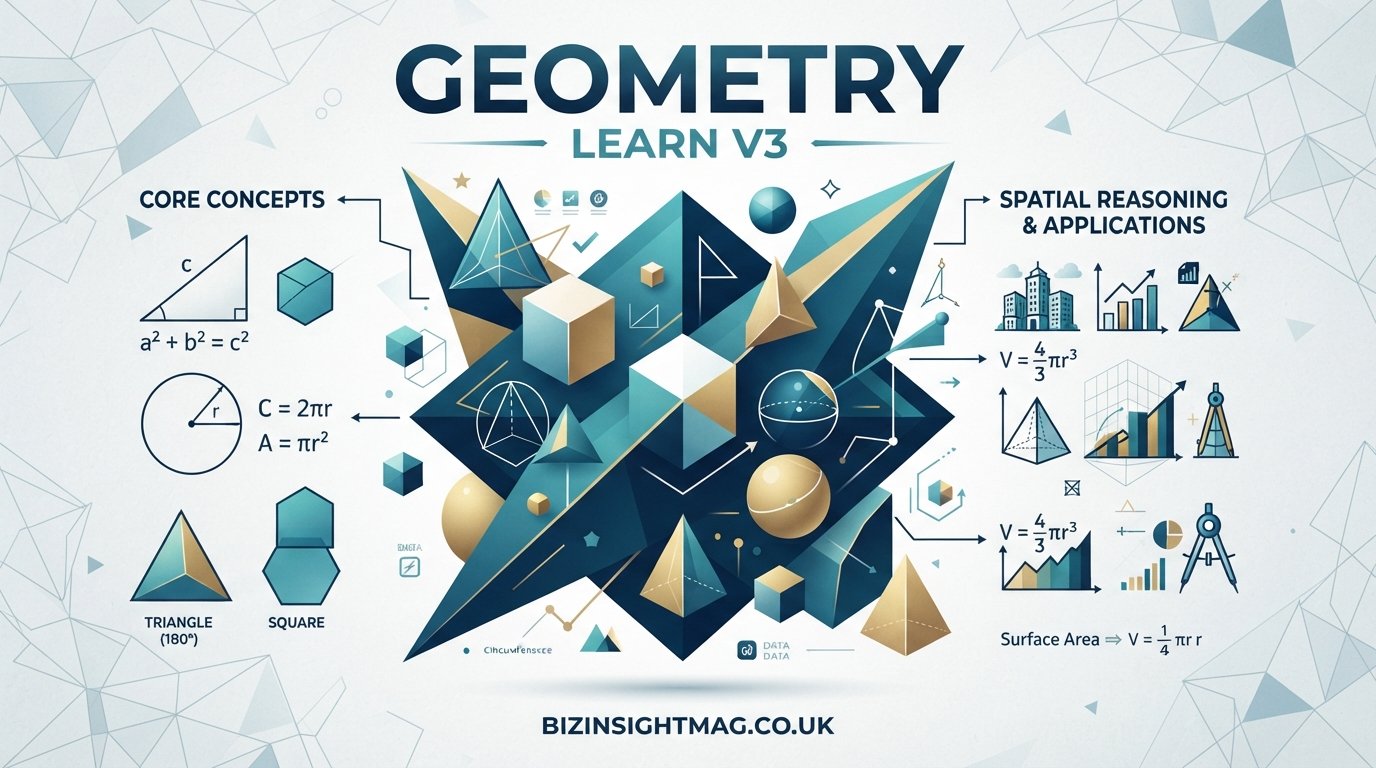
Geometry is one of the oldest and most fascinating branches of mathematics. It helps us understand shapes, sizes, distances, positions, angles, and the relationships between objects. From designing buildings and creating digital graphics to planning roads and studying space, geometry plays an important role in everyday life. As educational technology continues to develop, learners are also looking for modern and interactive ways to study mathematical concepts. This is where the idea of Geometry Learn V3 can be especially useful.
The phrase “Geometry Learn V3” may refer to a modern version, learning resource, educational platform, or structured approach designed to make geometry easier to understand. Regardless of the exact context, the concept highlights an important goal: learning geometry through clear explanations, visual examples, interactive practice, and logical problem-solving.
In this comprehensive guide, we will explore the fundamentals of geometry, important concepts learners should know, how a modern geometry learning approach can help students, common challenges, practical applications, and effective strategies for improving geometry skills.
What Is Geometry Learn V3?
Geometry Learn V3 can be understood as a modern approach to studying geometry. The “V3” element suggests a third version or updated learning experience, potentially involving improved explanations, better exercises, interactive tools, or a more organized educational structure.
Traditional geometry lessons often rely heavily on textbooks, formulas, and diagrams drawn on paper. While these methods remain valuable, modern learners can benefit from digital tools that allow them to explore shapes and mathematical relationships dynamically.
A modern geometry learning system may help students visualize concepts such as triangles, circles, polygons, angles, coordinate planes, and three-dimensional objects. Instead of simply memorizing formulas, students can learn why those formulas work and how to apply them to real problems.
This type of learning can be especially helpful for students who find abstract mathematical ideas difficult. When a learner can see a shape change as its dimensions are adjusted, the relationship between different measurements becomes easier to understand.
Why Is Geometry Important?
Geometry is not just about solving problems in a mathematics classroom. It is a practical subject that appears in many areas of life.
Architects use geometry when designing buildings and structures. Engineers rely on geometric calculations when developing machines, bridges, vehicles, and infrastructure. Artists use geometric principles to create balanced compositions, patterns, and perspective. Computer programmers and game developers apply geometry to graphics, animation, and virtual environments.
Even simple activities involve geometry. Measuring the size of a room, calculating the area of a garden, determining the shortest distance between two locations, or estimating how much material is needed for a project can all involve geometric thinking.
Learning geometry also develops logical reasoning. Students learn how to observe relationships, identify patterns, analyze information, and reach conclusions based on evidence. These skills can be useful far beyond mathematics.
Understanding the Basic Elements of Geometry
Before exploring advanced concepts, students need a strong understanding of the basic building blocks of geometry.
The most fundamental element is a point. A point represents an exact position in space and has no length, width, or height.
A line extends infinitely in both directions. A line segment, on the other hand, has two endpoints and a specific length.
A ray begins at one endpoint and continues infinitely in one direction.
These simple ideas form the foundation for more complicated geometric structures. For example, angles are created when two rays share a common endpoint. Understanding these definitions makes it easier to study more advanced topics later.
A modern learning approach should introduce these concepts gradually. Rather than presenting a large number of definitions at once, learners can study each idea through diagrams and practical examples.
Learning About Angles
Angles are a central part of geometry. An angle is formed when two rays meet at a common endpoint, known as the vertex.
Angles are commonly classified according to their measurements. An acute angle measures less than 90 degrees. A right angle measures exactly 90 degrees. An obtuse angle is greater than 90 degrees but less than 180 degrees. A straight angle measures 180 degrees.
There are also reflex angles, which measure more than 180 degrees but less than 360 degrees.
Understanding angles is essential because they appear in triangles, polygons, circles, architecture, navigation, and many other applications. Students should practice identifying different types of angles visually before moving on to calculations.
Interactive geometry tools can make this process easier by allowing learners to rotate lines and observe how the angle changes.
Exploring Different Types of Shapes
One of the most enjoyable parts of geometry is learning about shapes. Two-dimensional shapes are flat figures that have length and width but no depth.
Common two-dimensional shapes include:
- Triangles
- Squares
- Rectangles
- Parallelograms
- Rhombuses
- Trapezoids
- Pentagons
- Hexagons
- Circles
Each shape has unique properties. A square has four equal sides and four right angles, while a rectangle has opposite sides equal and also contains four right angles.
A triangle has three sides, but triangles can be classified in different ways. Based on side lengths, they may be equilateral, isosceles, or scalene. Based on angles, they may be acute, right, or obtuse triangles.
A strong geometry learning system should encourage students to compare these shapes instead of memorizing definitions separately. Comparing properties helps learners recognize patterns and understand how geometric figures are related.
The Importance of Triangles in Geometry
Triangles are among the most important figures in geometry. They are simple but powerful shapes that appear in construction, engineering, design, and mathematics.
One of the most famous principles involving triangles is the Pythagorean theorem. For a right triangle, the relationship between the two shorter sides and the hypotenuse is expressed as:
a² + b² = c²
Here, a and b represent the legs of the right triangle, while c represents the hypotenuse.
This theorem can be used to calculate an unknown side when the other two sides are known.
For example, if a right triangle has legs measuring 3 units and 4 units, the hypotenuse is 5 units because:
3² + 4² = 5²
The Pythagorean theorem is a perfect example of how geometry connects visual shapes with algebraic calculations.
Perimeter and Area
Perimeter and area are two fundamental measurements that students encounter frequently.
The perimeter is the total distance around a two-dimensional shape. To find the perimeter of a rectangle, for example, you add all four sides together.
The area measures the amount of space inside a two-dimensional shape.
For a rectangle, the area is calculated using:
Area = length × width
For a triangle, the formula is:
Area = ½ × base × height
Circles have their own important measurements. The area of a circle is:
Area = πr²
Here, r represents the radius of the circle.
Understanding when to use perimeter and when to use area is just as important as remembering the formulas. Real-world examples can make these concepts easier to Geometry Learn V3 understand. For instance, fencing a garden requires perimeter calculations, while determining how much grass seed is needed requires area calculations.
Understanding Circles
Circles are unique geometric figures with no straight sides. Every point on the circumference is the same distance from the center.
Several important terms are associated with circles. The radius is the distance from the center to the edge. The diameter passes through the center and connects two points on the circumference. The diameter is twice the radius.
The circumference is the distance around the circle, while the area represents the space inside it.
Students often find circles challenging because they involve the constant π, commonly approximated as 3.14. Interactive visualizations can help learners understand why Geometry Learn V3 the formulas for circumference and area work.
Instead of simply memorizing formulas, students can explore how changing the radius affects the size of the circle.
Coordinate Geometry and the Coordinate Plane
Coordinate geometry connects geometry with algebra. It allows points and shapes to be represented using numbers.
The coordinate plane consists of a horizontal x-axis and a vertical y-axis. These axes intersect at the origin, usually represented as (0, 0).
A point is written as an ordered pair such as (3, 5). The first number represents the x-coordinate, while the second represents the y-coordinate.
Coordinate geometry allows students to calculate distances between points, identify midpoints, and study lines.
For example, the distance formula can be used to find the distance between two points. This approach demonstrates how geometric problems Geometry Learn V3 can be solved using algebraic reasoning.
Coordinate geometry is also important in computer graphics, mapping, robotics, and game development.
Transformations in Geometry
Transformations describe how geometric figures move or change position.
The main types include translation, rotation, reflection, and dilation.
A translation moves a figure from one location to Geometry Learn V3 another without changing its size or orientation.
A rotation turns a figure around a fixed point.
A reflection creates a mirror image across a line.
A dilation changes the size of a figure while maintaining its overall shape.
These concepts are particularly well suited to interactive learning. Students can move shapes across a coordinate plane and immediately see how their coordinates change.
Understanding transformations also introduces Geometry Learn V3 learners to symmetry and spatial reasoning.
Congruence and Similarity
Two figures are congruent if they have the same shape and size. They may be positioned differently, but their corresponding sides and angles are equal.
Two figures are similar if they have the same general shape but may have different sizes. Their corresponding angles are equal, while their corresponding side lengths are proportional.
These concepts are important in architecture, photography, scale drawings, maps, and model construction.
For example, a small model of a building can Geometry Learn V3 be similar to the actual building. The model uses the same proportions but has smaller dimensions.
Learning through visual comparisons can make congruence and similarity easier to understand.
Three-Dimensional Geometry
Geometry is not limited to flat shapes. Three-dimensional geometry focuses on objects that have length, width, and height.
Common three-dimensional figures include cubes, rectangular prisms, cylinders, cones, pyramids, and spheres.
Students often learn about surface area and volume when studying these objects.
Surface area represents the total area of the Geometry Learn V3 outside surfaces of a three-dimensional object. Volume measures the amount of space the object occupies.
For a rectangular prism, volume can be calculated as:
Volume = length × width × height
Three-dimensional geometry has many practical applications. Packaging designers calculate volume to determine how much a container can hold. Engineers Geometry Learn V3 study the dimensions of structures, while manufacturers use geometric calculations to design products.
How Geometry Learn V3 Can Support Students
A modern geometry learning experience can support students in several ways.
First, it can make abstract ideas more visual. A diagram can often communicate a geometric relationship faster than a paragraph of text.
Second, interactive exercises can provide immediate feedback. When students make mistakes, they can review the process and try again.
Third, structured lessons can help learners progress from basic concepts to advanced topics without becoming overwhelmed.
Another advantage is flexibility. Digital learning resources may allow students to study at their own pace. Someone who struggles with angles can Geometry Learn V3 spend more time practicing angles before moving to triangles or trigonometry.
The best learning experience combines explanations, visual demonstrations, practice questions, and real-world applications.
Common Challenges Students Face When Learning Geometry
Many students struggle with geometry because it combines visual reasoning with mathematical calculations.
One common problem is difficulty understanding diagrams. A student may know a formula but fail to identify which measurements are relevant.
Another challenge is memorizing too many formulas. Students sometimes attempt to memorize formulas without understanding what each formula represents.
A better strategy is to connect every formula with Geometry Learn V3 a visual explanation. For example, understanding that rectangle area represents the number of square units inside a shape makes the formula more meaningful.
Students may also struggle with geometric proofs. Proofs require logical reasoning and careful attention to definitions and relationships. Regular practice can gradually improve these skills.
Effective Ways to Learn Geometry
Learning geometry successfully requires more than reading definitions. Students should actively engage with the subject.
Start by mastering the basics. Make sure you understand points, lines, rays, angles, and common shapes before moving to complex topics.
Draw diagrams whenever possible. Even a simple sketch can make a difficult problem easier.
Practice regularly. Geometry skills improve through repetition and exposure to different types of problems.
Try to explain solutions in your own words. If you can describe why a particular formula or theorem works, you probably understand the concept more deeply.
Use mistakes as learning opportunities. When an answer is incorrect, review each step to determine where the reasoning went wrong.
Finally, connect geometry to real life. Look around your environment and identify shapes, angles, symmetry, and patterns. This makes geometry feel Geometry Learn V3 less like an isolated school subject and more like a practical way of understanding the world.
Geometry in Everyday Life
Geometry is everywhere.
Buildings contain geometric shapes and patterns. Roads involve angles, distances, and curves. Furniture is designed using measurements and Geometry Learn V3 proportions. Sports fields rely on carefully calculated dimensions.
Photography uses perspective and composition, while interior design depends heavily on space and proportion.
Even smartphones and computer screens involve geometric principles. Digital images are created using pixels arranged in grids, and computer graphics rely on coordinate systems and mathematical transformations.
Recognizing these examples can help students appreciate why geometry matters.
The Role of Technology in Geometry Education
Technology has changed the way mathematics can be taught. Instead of viewing static diagrams, learners can interact with geometric Geometry Learn V3 figures and observe changes in real time.
Digital tools can allow students to drag points, rotate shapes, adjust dimensions, and explore mathematical relationships.
For example, changing the radius of a circle can immediately demonstrate how its area and circumference change. Moving a point on a coordinate plane can show how distance and slope are affected.
Technology should not replace fundamental mathematical thinking, but it can make difficult concepts more accessible.
A modern learning concept such as Geometry Learn V3 can therefore represent a broader movement toward interactive, visual, and personalized Geometry Learn V3 mathematics education.
Why Practice Matters in Geometry
Geometry is a subject where consistent practice makes a major difference. Reading a formula once is rarely enough to master it.
Students should solve a variety of problems involving different shapes and situations. They should also practice explaining their reasoning.
For example, one problem may ask for Geometry Learn V3 the area of a rectangle, while another may require finding a missing side before calculating the area. These problems test different levels of understanding.
Regular practice helps students recognize patterns and select the correct method more quickly.
Building Confidence Through Step-by-Step Learning
Confidence is an important part of Geometry Learn V3 mathematical learning. Students who believe they are “bad at geometry” may avoid challenging problems, which can make progress more difficult.
A step-by-step approach can help.
Begin with simple definitions. Move to basic calculations. Then introduce multi-step problems. Once students are comfortable, they can explore proofs, coordinate Geometry Learn V3 geometry, transformations, and advanced topics.
Each successful step builds confidence.
The goal is not simply to arrive at the correct answer. The real goal is to understand the reasoning behind the answer.
Final Thoughts on Geometry Learn V3
Geometry Learn V3 represents the idea of approaching geometry through a modern, organized, and engaging learning experience. Whether it refers to a specific educational resource or simply a version of a geometry learning method, the underlying principle remains valuable: students learn best when mathematical ideas are clear, visual, interactive, and connected to real-world situations.
From points and angles to triangles, circles, transformations, coordinates, and three-dimensional objects, geometry provides a powerful framework for understanding Geometry Learn V3 space and relationships. It develops logical thinking while offering practical skills that can be applied in architecture, engineering, technology, design, art, and everyday life.
The most effective way to learn geometry is to combine understanding with practice. Instead of memorizing formulas without context, learners should explore why formulas work, draw diagrams, solve problems, and connect mathematical concepts to real situations.
With the right approach, geometry does not have to feel complicated or intimidating. It can become an exciting subject that encourages curiosity, creativity, and problem-solving. A structured learning approach such as Geometry Learn V3 can help students build that foundation and gradually develop the confidence needed to tackle increasingly challenging mathematical ideas.
